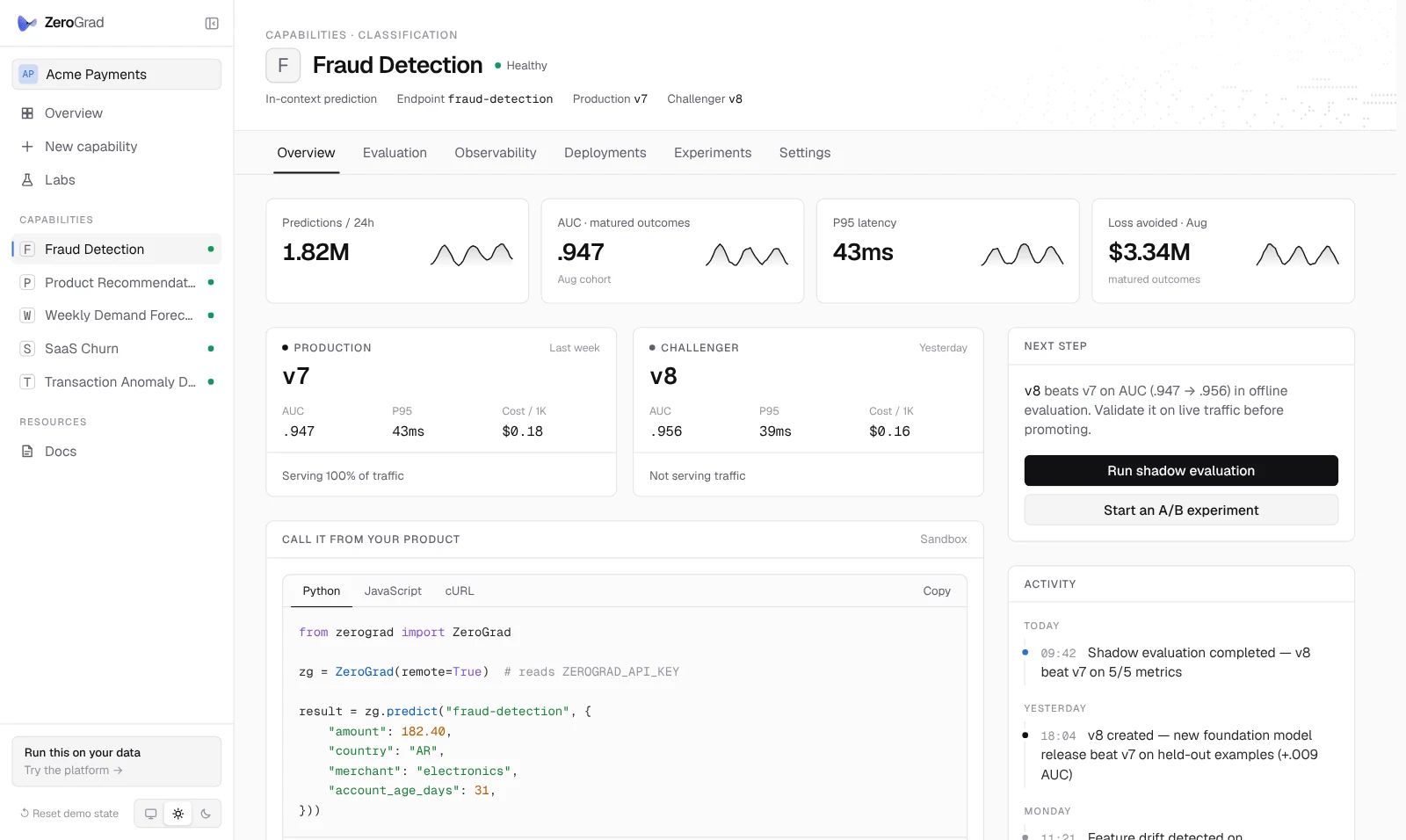
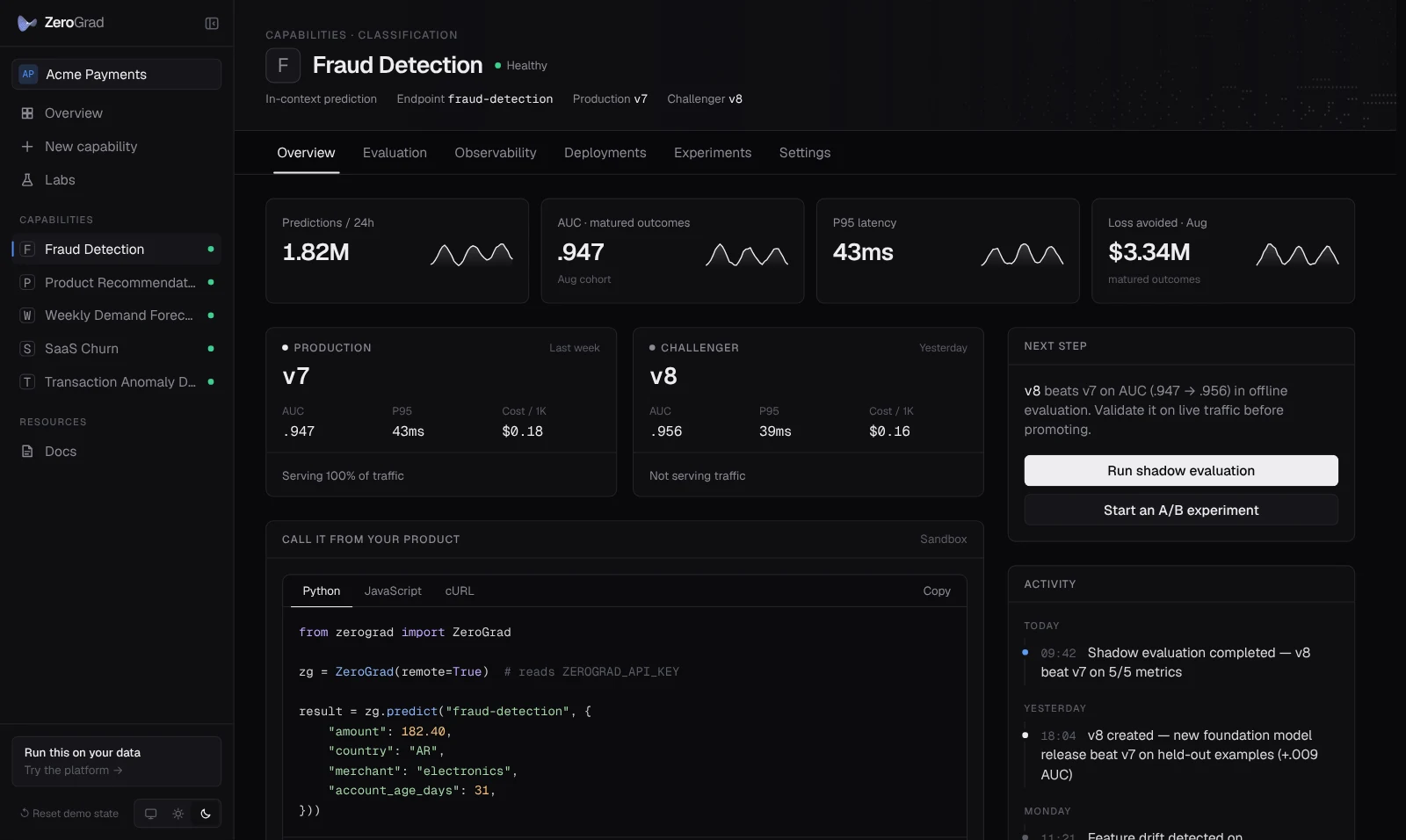
Run it yourself, or let us run it.
The SDK is complete on its own: stay open source and self-hosted for as long as you like. If you ever want us to run it, it is the same code: ZeroGrad() runs on your side, ZeroGrad(remote=True) on the platform.
Point it at your historical data, get back a prediction API. No training runs, no ML team. We’re in private alpha, working with a few design partners.
claude mcp add zerograd -- zerograd-mcpWorks with Claude Code, Cursor, Codex, Gemini CLI and any other MCP client.1from zerograd import ZeroGrad23zg = ZeroGrad() # runs on your machine45fraud = zg.create(6 "fraud-detection",7 examples="transactions.parquet", # past outcomes8 target="is_fraud",9 drop=["transaction_id"],10)1112fraud.predict({"amount": 1840, "country": "BR"})
{ "prediction": 1, "score": 0.94, "proba": { "0": 0.06, "1": 0.94 } }It's like ChatGPT, but for predictive tasks: get predictions over your data in minutes, without training a model.
You don’t retrain them every time you need a new task done. Show a few examples and they pick it up from context, without changing their weights: no feature engineering, no expensive retraining, no team tuning a model for each use case.
It was pretrained once, on millions of tables. Give it your history as examples and it predicts the next row: fraud, churn, demand. No training run, no tuning.
p(fraud) = 0.94
During 2026, tabular foundation models went from research papers to solid baselines. On many real datasets they already hold their own against gradient-boosted trees and deep learning.
Language went from one model per task to one pretrained model that gets better every few months. Tables are on the same path, and the next generation will likely beat what you run today.
Test them on your data, use them as your baseline, and be ready to adopt the next one the week it ships. That's the problem we solve.
Without depending on an expensive team. You ship fraud detection, not an XGBoost container: a handful of verbs cover most of the predictive work products need, and more are on the way. Some of what teams build with them:
The SDK ships an MCP server, so Claude Code, Cursor, Codex or any other MCP client can create capabilities and predict when you ask in plain language. It runs on your machine with no API key, and your data stays there: the agent passes file paths, never rows.
$pip install "zerograd[mcp]"$claude mcp add zerograd -- zerograd-mcpOther clients take the same command, zerograd-mcp, over stdio.
The SDK is open source and runs on your machine. The platform is the managed layer on top, for teams running predictions in production: you call one endpoint, and we run the evaluation, deployment, monitoring and upgrades.

The SDK is complete on its own: stay open source and self-hosted for as long as you like. If you ever want us to run it, it is the same code: ZeroGrad() runs on your side, ZeroGrad(remote=True) on the platform.
We watch for drift and re-run a championship on your latest data. The winner waits in shadow, ready to promote.
Every version runs in shadow first, then canary or A/B behind your SLOs, with one-click rollback.
v8 10% of traffic
New foundation models keep landing. We prove them on your workload and swap them in behind the same endpoint.
Every capability is an MCP tool with a Skill that says when to call it. Claude, Cursor, Copilot, LangGraph or your own loop.
→ fraud_detection.predict
probability 0.94 · model v7
Blocking it: 94% is over the 0.90 threshold.
You do two things: describe the prediction and call the endpoint. Everything in between is ours, and every number comes with the model, the data window and the measured error behind it.
See it in actionPoint at past outcomes and say what you want predicted. Nothing gets trained.
Validation, candidate approaches and temporal backtests — on your history, not a benchmark.
An autoscaled endpoint, with monitoring and drift checks on from the first request.
classify · estimate · detect · segment. Your application consumes an API; you don't manage models.
Quality, latency, data health and the business metric you actually care about.
A challenger beats production on your data, under your constraints.
Proven on live traffic, behind the SLOs and guardrails you set.
Promoted with instant rollback. You change zero code.
We're working with a few design partners who have real predictive workloads. Bring a historical dataset; leave with a benchmark.